
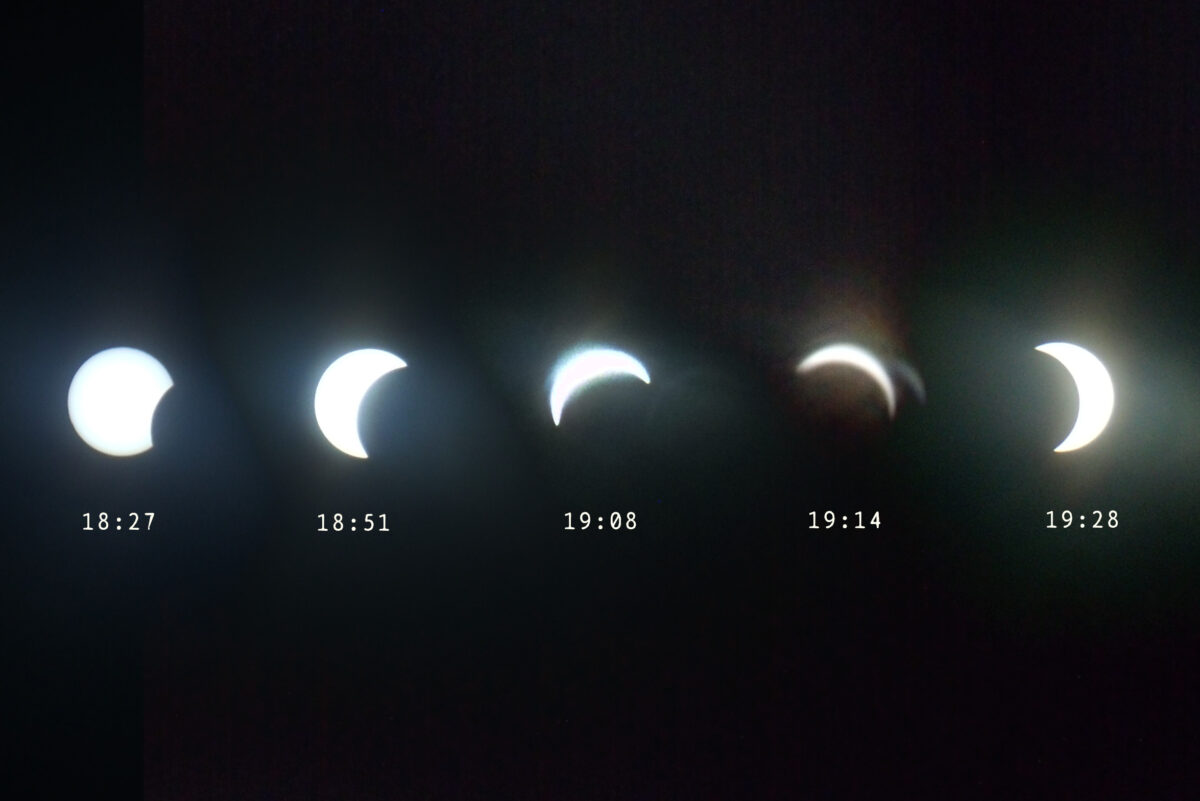
On the evening of the eclipse, about twenty of us came into the garden to watch its progress. There were a similar number of garden volunteers on Wanstead Flats. In the garden, we had seats, tables and shelter. On the Flats they could watch it to the very end. In either place, the eclipse was a celebration, bringing people together for that hour or so, with awe and wonder, reminding us that we are a planet in space.
The sun is 400 times bigger than the moon, but it is 400 times further away, so they appear the same size, and is why we can have an eclipse, with the moon ‘covering’ the sun. This coincidence in apparent size won’t continue as the moon is moving away from the earth. Rather slowly, at about 4 cm a year. NASA reckons in around 600 million years, the moon, as seen from earth, will no longer cover the sun. The end of total eclipses.
Total eclipses are rare. The last in UK was in 1999 and only fully observable in Devon and Cornwall. The next total eclipse in the UK is in 2090, though with a deep partial in 2081 (over 90%). I shall be long gone by then, so I am glad I witnessed this one.
The 1999 solar eclipse was 97% in London. A few weeks before, knowing it was on the way, I saw advertised in the magazine Astronomy Now, solar film manufactured by Baader, a German company. The film is used to make filters for telescopes but could be used for solar glasses. It cuts out 99.999% of light, which means only 1 part in 100,00 gets through. Safe enough.
Back in 1999, I ordered an A4 sheet, costing £11, and with Forest Gate Woodcraft Folk made solar glasses for the eclipse, which occurred on August 11 1999. You don’t need much for solar specs, postage stamp size for each eye is ample. We made about 20 at the Woodcraft session but I had quite a bit of the film left over, and I have been using it since. But after tonight, I have just a few scraps left.
There has been panic buying for solar specs with the build up to tonight’s eclipse. Even Greenwich Observatory ran out. I had a pair from the Sky at Night magazine, and made another two pairs with the solar film. With some more of the film, my daughter and I made a filter for her camera so she could take photos of the eclipse, including the one above.
Our merry group came with colanders and homemade pinhole cameras. I shared the specs. We had a totally clear night, no cloud at all. The colanders were effective, acting as multi pinholes, showing a lot of eclipsed suns as the event progressed. The homemade pinhole cameras varied in effectiveness. The hole should be circular and not too large. A pinhole effect that surprised us was that through the trees onto the estate wall, showing 100s of crescent shadows.
Everyone had use of the specs, as they were passed around. A few people used scraps of the solar film to cover their phone lens to take photos of the eclipse.
The eclipse in London tonight was 91% at its peak. At that point, it became quite dark and eerie with shadow. From then on, as the sun and moon moved apart in their separate orbits, the eclipse effect grew less. First contact had been at 6.13 pm. Peak was an hour later at 7.13 pm, and last contact at 8.03 pm. Those on the Flats could watch the eclipse till the end, but in the garden the sun was lost behind buildings about 7.35. But we had seen the build up, had the peak with its darkness, and the ebb until we lost the sun.
It was a memorable evening and I was happy to be part of it.