
We have had no rain since 27 June. That’s 35 dry days. We are in a drought, as evidenced by our flagging plants. Lack of rain has been made worse by the hot weather where much of our watering evaporates before plants can use it. There’s a hosepipe ban, but at least we have our tap, and how necessary it is, if we are to keep the garden alive.
The flax project is coming to an end. I did six days of retting detailed in my last blog. That was when I soaked the flax in water in a barrel to separate the inner wood (boon) from the external fibre. After three days of soaking, I tested the flax daily, as too long is detrimental to the flax fibres. Six days seemed right.
I removed the wet flax from the barrel and gave it a wash with clean water, as retting is a rotting process that breaks down the pectins sticking the fibre to the boon. It became very smelly and was attractive to flies. Having washed the flax, I left them in the sun to dry. The valuable, smelly water, I used to water plants.
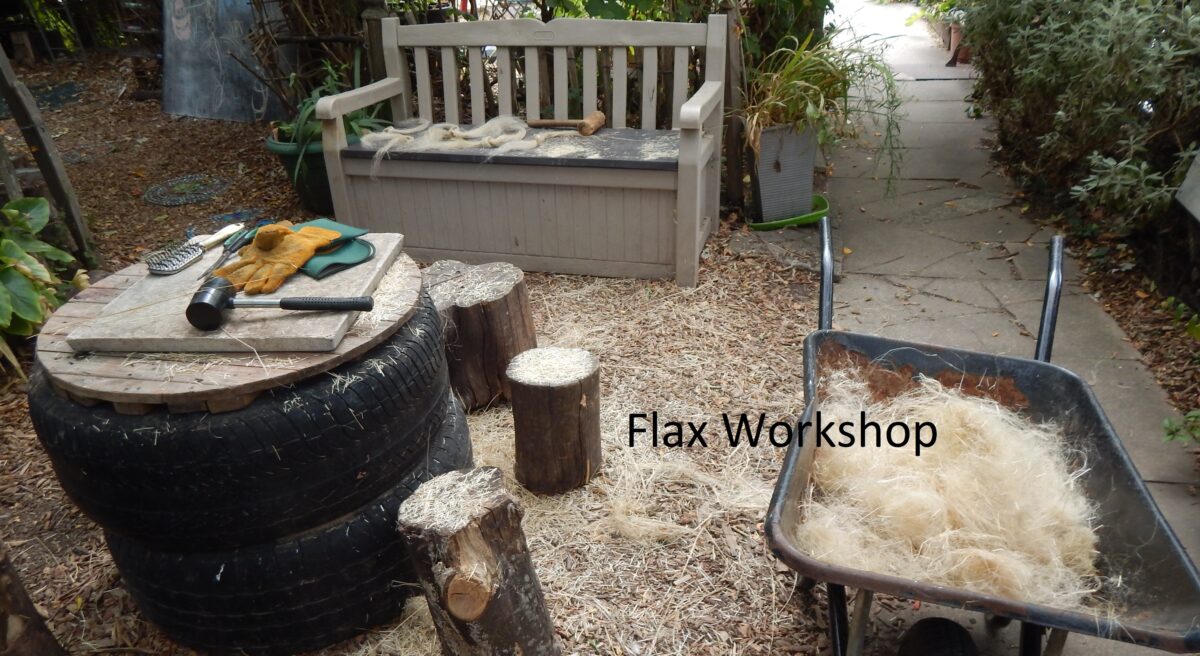
After a couple of days, I set to work on the flax. With the retting done, it was now down to separating the fibre from the inner boon. I found a table in the shade, put a concrete slab on the table, and with a rubber mallet hit the flax repeatedly. I took sheaves of it, laid it on the slab, and hit it, starting at one end, every half an inch or so. This breaks the boon but the fibre is fine. Having broken the boon, I then used a hairbrush, donated by daughter, and repeatedly brushed a sheaf. The broken bits of boon came out and I was left with long strands of flax fibre. It is blonde and fine, very like hair. Which is why we say flaxen hair, to describe fine blond hair.
I repeated the process with all the sheaves of flax, until I had six flax fibre bundles. These were long fibres, the best for spinning and weaving. The short fibred flax I threw into a wheelbarrow. And put on the compost heap. This was a mistake, as I found a couple of days latter in a YouTube video. They could still be spun. I went to get them from the compost heap, but they were thoroughly covered and irretrievable.
With the long fibred flax, I combed and brushed out any remaining bits of boon. I wound some on a stick but was aware it was probably weak. I bought a couple of drop spindles to make the flax yarn stronger. Drop spindles were used before the spinning wheel was invented. By spinning the spindle itself you make the flax yarn stronger as you are adding twists. I had several sticks full. One was crocheted. Another I wove using a six inch square of cardboard. I notched the cardboard down opposite sides, and put on the warp yarn. This is the yarn that doesn’t move. Once in place, it’s under, over the warp repeatedly with the weft, until I had filled the card, and had a small example of woven flax. This had been my aim from the beginning, to go from seed to weave. I have a little fibre left which is going to be knitted.
And that will be that for the flax project this year. The seed was sown in late March, harvested in late June, dried as a stook, then retted. Once the retting was done, we had breaking and brushing to get out the fibre. The fibre was spun, and finally the flax yarn was used to make some samples to show its use.
I am considering running a flax class next year. To go again from seed to flax fibre but with a class this time round. We will grow flax again in the garden, but in addition attendees will be given seed to grow at home in their garden or window box if they haven’t one. And we will process our crop together. With a lot more flax, if I can get funds, we’ll get a spinning wheel which we could use year on year for flax but for wool too. Failing to get funds, we will use drop spindles and spin like medieval folk. I am looking forward to working with others on next year’s project. Any takers out there?