
It is chilly today, around 14 degrees and windy making it feel colder as the wind takes away heat. This is the end of Indian summer, leaving us with weather more akin to the average in October. We are in mid autumn, Keats’s season of mists and mellow fruitfulness is over. There are seeds but no longer fruit, mist yes, and very likely frosts to come as we close in on winter. The longer nights are giving us colder morning. The sun rose at 7.15 today and will set at 18.17, giving a day of 11 hours and a longer night of 13 hours. Several weeks past the equinox, the nights are winning out and will continue to do so until we get to the Winter Solstice in late December.
The term Indian summer, for the autumnal warm weather we have been having, has nothing to do with India. It comes from North America. Early European settlers observed that Native American tribes used this mild, late-autumn weather to continue hunting, gathering crops, and building up food and firewood supplies before winter. Very important for a nomadic life on the plains.
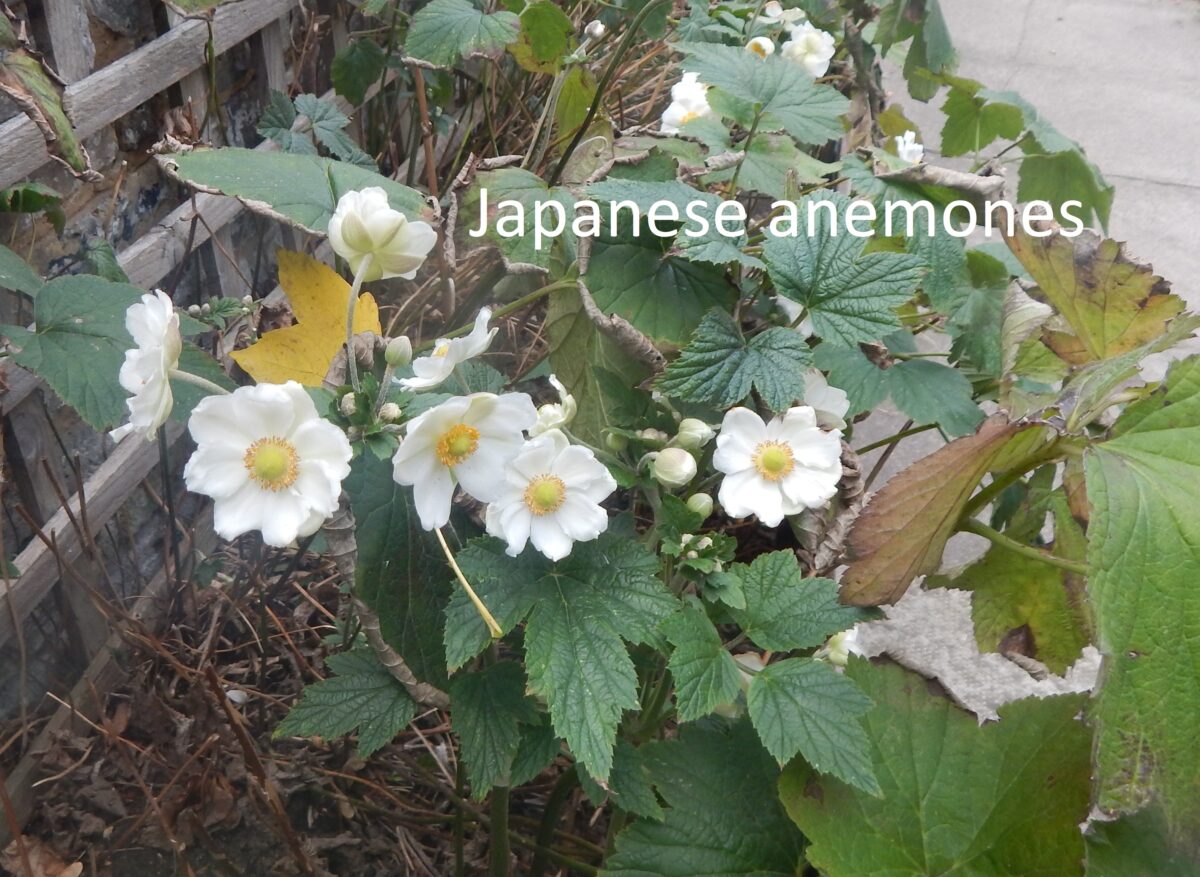
Most of the trees in the garden still have their leaves. November is the main month for leaf fall. We gather seeds from agapanthus. It is a time for chopping back. There are few flowers around. I note a Japanese anemone near the mid gate in flower and nearby hot lips with its red and white flowers, reminiscent of snapdragons. A cluster of Michaelmas daisies near the main gate are fading. Michaelmas is the feast of St Michael and all Angels. At Oxbridge Universities this term is called Michaelmas term.
While drinking coffee we had a discussion about the Anthropocene. This was proposed as a geological epoch but was rejected by the International Union of Geological Science in 2024. The proposers argued that humans are making so much change in the world with extinctions, global warming effects, plastic pollution, and extensive cities that it deserves a new epoch. This was rejected, as it was felt human intervention began much earlier with the advent of agriculture and forest clearance ten thousand years ago.
When the Anthropocene began is not clear, some say 1952 with the hydrogen bomb and its resulting radioactivity, others argue for early in the industrial revolution when James Watt installed his first steam engines, in 1776. He did not invent the steam engine but with the external condenser made it much more efficient. Thus began the factory era and 50 years later passenger and freight trains began. The industrial revolution was dependent on coal, giving us the dirty fogs of Victorian Britain, continuing until the clean air acts of the 1950s. Anthropocene is used by historians and geographers but has has been scorned by geologists. For them, we are living in the Holocene which began around 12 thousand years ago when the last ice age ended.
Even that to geologists is regarded as yesterday. They deal in millions of years, hundreds of millions, billions even. Chalk, a young rock, was laid down in the Cretaceous around a 100 million years ago. The oldest on earth, not really a rock but crystalline deposits, is zircon (zirconium silicate) which is found in the Jack Hills of Western Australia and dates from 4.4 billion years ago. There is not much very old rock on earth, as plate techtonics sucks under rock and provides newer rock as it slowly moves the continents around the planet.