
It’s mild, about 21 degrees, overcast, a dirty white carapace, teasing us with the suggestion of rain we so badly need, but don’t get. There is still a hosepipe ban, this late in the year. The warm weather is both welcome and somewhat scary, as we envisage what climate change has in store in future years. We are at about 1.5 degrees of warming, but it is not slowing down. All the fossil fuels (gas, petrol, aviation fuel and coal) we continue to burn guarantees more warming.
At the last COP (COP 30 in Brazil) there were around 1600 fossil fuel lobbyists. Their job is to mute the final statement, making it more acceptable to their masters. The next COP is in Turkey in mid November. I am in two minds as to whether there is any point to them. But they at least spread the news. But Reform doesn’t believe in man made climate change at all. Trump calls it a hoax. As for Putin, with his masses of drones aimed at Ukraine, he is doing his very best to increase global warming. We should have a prize for the biggest villains, like the Ignoble Prize, which is for useless science projects. This one to be called perhaps the Global Warmer Prize. I would split it between Putin and Trump for 2026.
Around, the garden in bloom are hot lips, a few Japanese anemones, marigolds of course, a few penstemons, a rose or two. There’s a teasel near the side gate with three of its harsh brushes. The names indicates its former usage. For centuries, artisans known as fullers mounted dried teasel heads onto hand held frames or cylinders and brushed them across woven woollen fabric. The stiff, hooked spines combed out loose fibres to give a uniform finish as in the fabric flannel. If a teasel head struck a knot in the cloth the spine would break, unlike steel wire cards. They are still occasionally used for cashmere or billiard table felt.
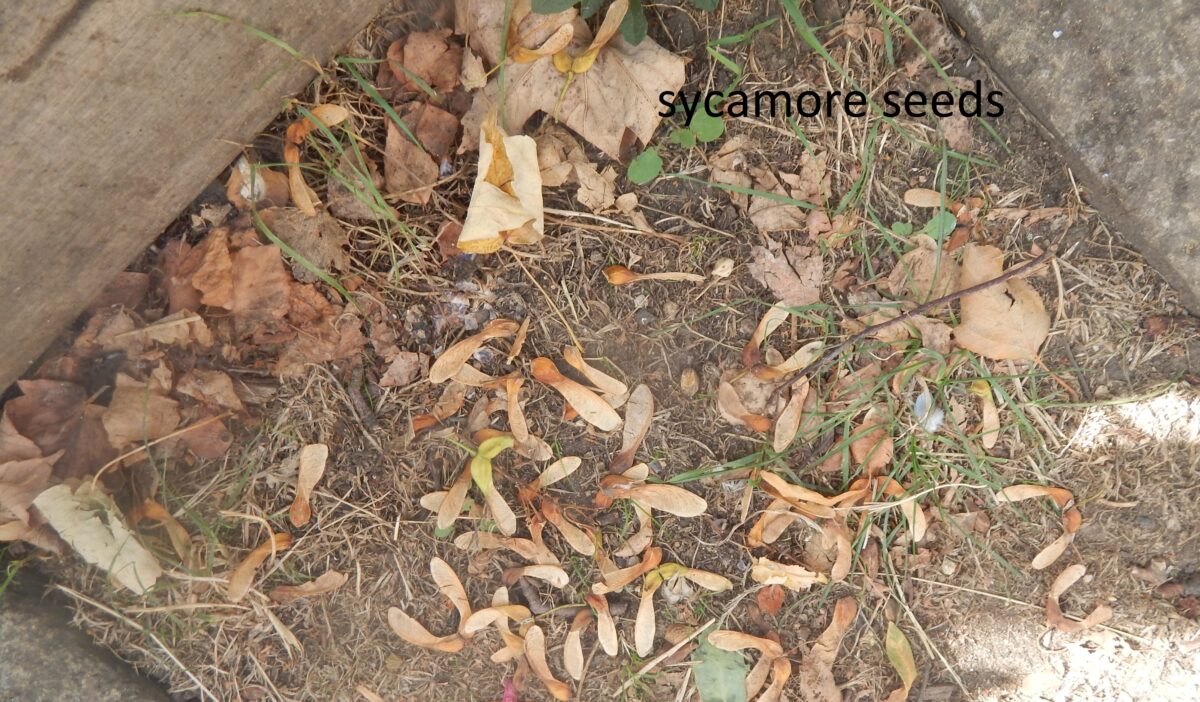
There are lots of sycamore seeds on the ground, rather wasted in the garden as we sweep them up or hoe them out of the flower beds. But the shear number allows one to envisage how sycamores can take over, say a piece of waste ground, with the helicopters everywhere, in competition with buddleia.
A frog climbed up to the pond, I am told. I am surprised any adults are alive with the hot dry summer we have been through. I looked for it, but haven’t seen it. The pond would be a good place these dry days. I hope we can get some tadpoles in the spring. We got none at all last year, and in the end were donated some.
A dead fox was found in the Dare to Dream shelter. Diseased most likely. We all die of course, but it is not pleasant to find. In the Dare to Dream are two book houses now. I always think it is somewhat out of the way as it gets few visitors. Do we dare to dream or should be realists?
I am waiting for the fothergilla to go through its autumn cycle, with the leaves turning red-brown before falling. Once dormant, I will dig it up and plant it in a large ceramic pot in a more open spot. It is very out of the way now in the Fothergill bed, hidden behind a large marigold cluster. The plant deserves better, commemorating the 18th century plant collector.
I have been telling people about the flax project which I intend holding in 2027. I will advertise it in January, and we’ll meet in February for the introductory session. We will plant flax again in the square bed we used this year, and I will invite others to plant some in their own gardens. The seeds will be sown at the end of March. I hope the ones I kept from the last crop are fertile. If they are not, I will have to buy some seed and plant it as soon as I can. We will continue meeting monthly until mid June when the crop is nearing its harvest. Then weekly, as we harvest, dry the stooks, do the retting, and get the fibres out of the plants for weaving or knitting. Having done it once, I am slightly more confident and it will be good to have a group sharing their experiences.