
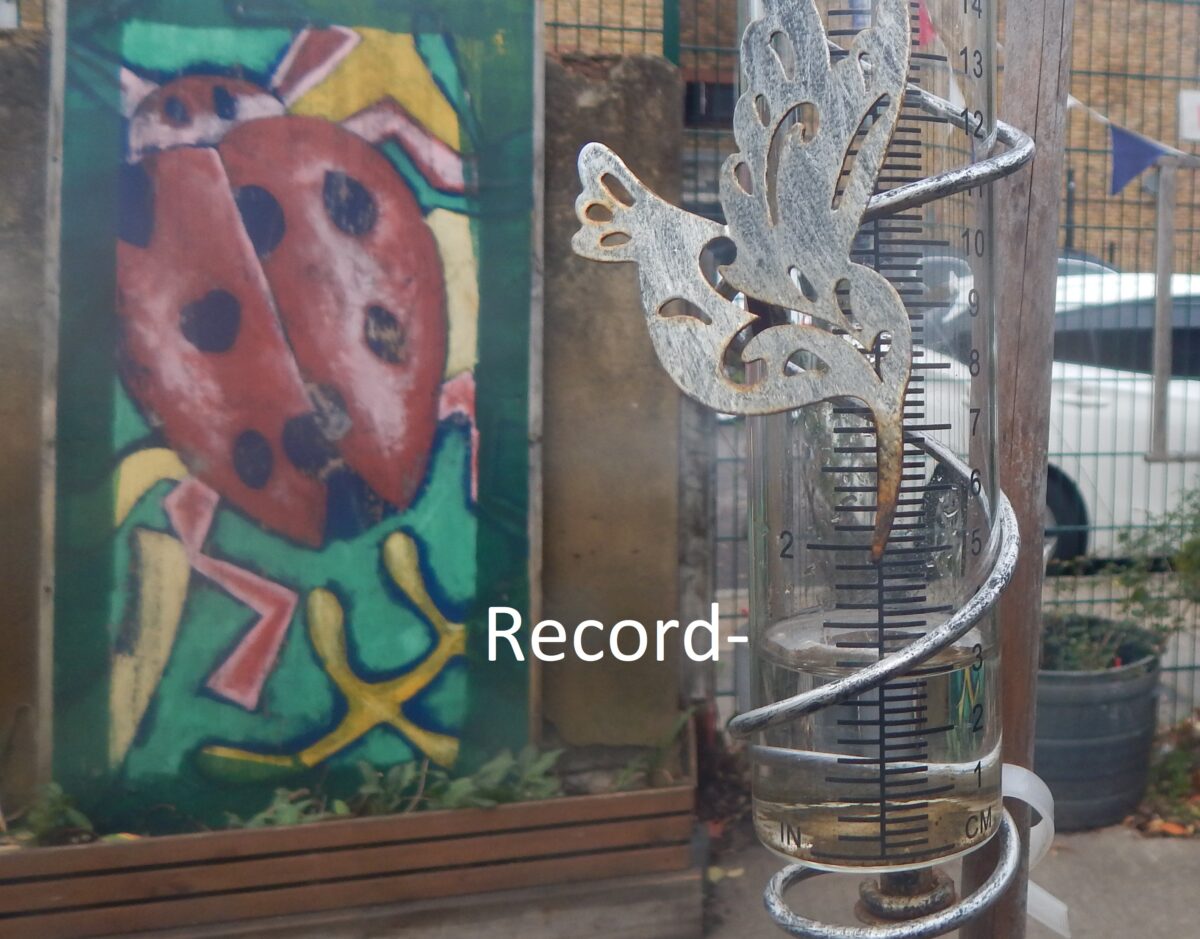
By the 22 October, we’d had 35 mm of rain in the month. The average rainfall in October in London is 70 mm. I thought with just nine days to go, it’s not going to make the average. And then we had storm Austen. Yesterday, I recorded 29 mm of rain on our garden rain gauge. That’s a record for one day. You won’t find it in the Guinness Book of records, but I have been tabulating the rainfall from our rain gauge since July 7 2025, and yesterday was the highest I have recorded. Just, as second was October 3 last year with 26 mm. Note October again, one of the wettest months of the year. So 64 mm so far with a week to go. We will surely beat the average. As I write this blog at 4pm, it is raining hard, and BBC Weather says it will keep raining until midnight.
Our metre cubes are full. They will be spilling over soon. Irony of ironies, as that is always true when we don’t need the water. The pond isn’t yet full, over 6 inches to go. It occurrs to me that you could use either a metre cube or the pond as a rain gauge. You would simply need to calibrate them using our rain gauge. A cube would be better as we add water to the pond in days of drought. But the cubes once full can’t measure any more. Though, I might try calibrating a cube anyway, once the level is low.
The human race is utterly dependent on water, for drinking, cooking, washing, for industry, for farming, and in our gardens. Life needs water as the planet Mars illustrates. There may have been life there billions of years ago, but now Mars is the driest of deserts, utterly without any living thing in its barren expanse.
In the garden, we would have had a struggle this summer without our tap. Though, it has caused us trouble as we had a leak in the spring, and we are still trying to negotiate our way out of the bill. The leak has been repaired twice and we are keeping a keen eye out for any future leaks, as they can be so costly.
Farmers have been having a dreadful time with repeated dry summers. Some are thinking of getting out altogether, others wondering what is best to plant and when. It’s a hard way to make a living as drought is so unpredictable. I note more are going to grow vines as our climate warms. Well, OK for them, but what does that do for our national food policy? You can’t live on wine.
This is the ongoing conversation – how can we feed the nation in such fractious times, with the war in the Middle East pushing up the price of fuel and fertiliser, and climate change to contend with too. In the short term we are being told to stock up on water and non-perishable food, in case AI and determined hackers hit the programs that allow supermarkets to control the temperatures of freezers or cause power cuts that do the same domestically, and render the food in our freezers and fridges unusable. Wind-up radios are selling like hot cakes, so we can be told how bad things are.
We come back to water; what to do if the hackers stop it flowing. The government says keep some bottled water in case. But how much and how do you keep it drinkable if you have to keep it for months? When I was young and backpacking the world, I had a little bottle of iodine with a dropper as local water frequently wasn’t safe. You add a couple of drops to a half litre to kill any bugs. A tip I hope you won’t need.
On 25 September, I wrote in the garden blog:
‘The silver birch has lost most of its leaves. That is so early. It is surely reacting to water shortage, made worse by the heat. The summer has been the hottest on record for the UK, says the Met Office.’
In today’s Guardian I read:
‘The birch has lost all its leaves,’ says Guy Barter, the chief horticulturist of the RHS [indicating a large tree in Wisley.] ‘That’s the effect of drought… After the hottest summer on record, the tree has dropped its canopy early…choosing not to lose water through its leaves. This is known as false autumn.’
Glad someone is reading my blogs.
Comments 4
Fantastic read Derek, always much food for thought, and tying in our experiences in the Garden to developments world wide.
Indeed- a really good read. Derek. Lots of information.
You’ve inspired me to get a water gauge. BTW, what’s a “cube” and how is it used?
A cube is one of our metre cubes. We have three of them. They each hold a 1000 litres of water, or a tonne. The most obvious one is the one opposite our sign in table. It is fed from the gutter and downpipe on the roof above it. Their proper name is IBC which stands for Intermediate Bulk Container. I prefer calling them a cube though, as it helps me envisage a tonne of water.