
It is cold, the pavement on Earlham Grove icy with frost. Frost on car roofs too, as I walk down to the garden. Car roofs are the most visible frosty surfaces. They are horizontal and so lose heat easily. Clear nights are the coldest as there are no insulating clouds. Car roof tops are metal, good conductors, so easily lose heat. The roof becomes colder than the surrounding air and so water vapour freezes in contact with the surface. This is enhanced by any dust which become crystallisation points for frost formation.
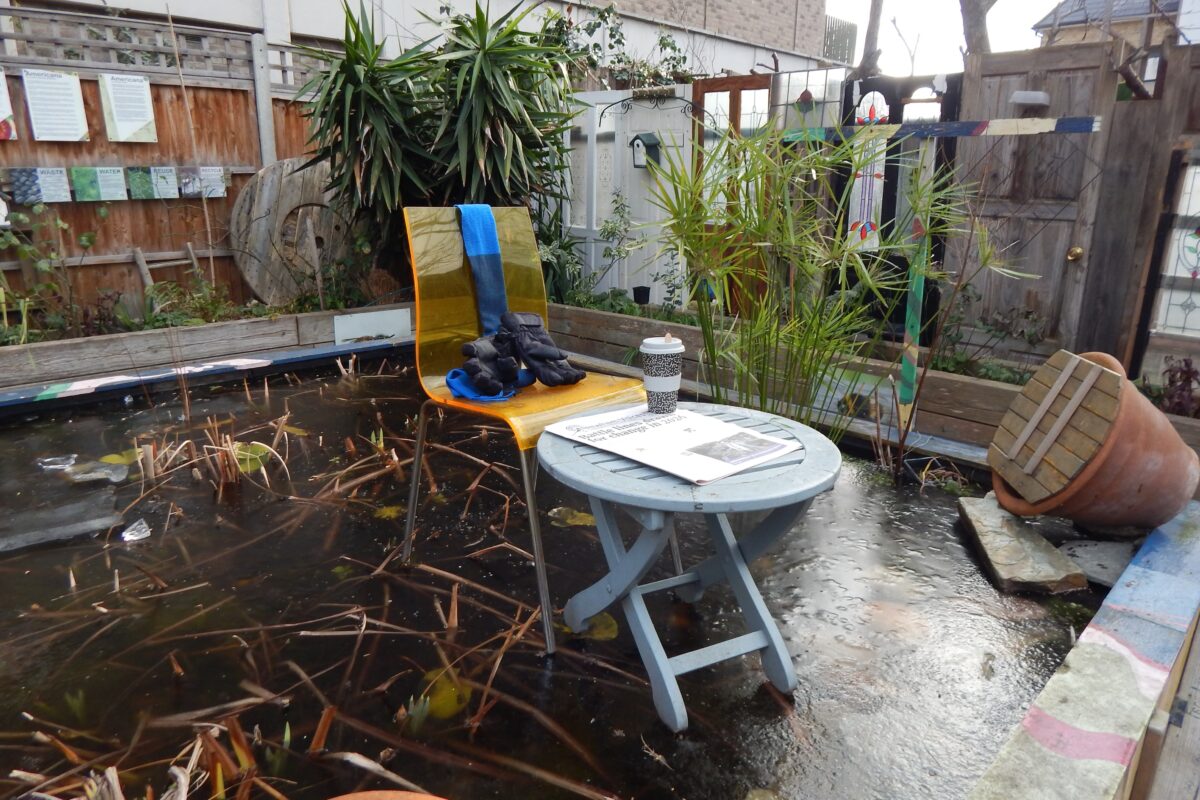
Our pond has been frozen over for quite a few days. It has been so cold that ice has built up day on day. Ice needs to be at least two inches thick to safely walk on. It has been broken, and a slab is about that thick, though I am not going to test it by attempting to walk across the pond. I find ice on ponds quite dramatic, a palpable sign of the cold, but it doesn’t photograph well. I have tried. You hardly know it is frozen in a photo, and of course you don’t feel the cold of it. You need something on the ice, say a bird, a cat or a person skating, their scarf flying out. Failing to have any of these, I set up my photo of the ice with a few props: a chair, a table, a newspaper, a mug, gloves and scarf. Well it amuses me, and no photographers got wet to take the shot, though he did get cold, sans gloves and scarf.
Some people think you should break the ice on the pond for the sake of pond life. But you don’t need to as it makes no difference. All the animal life in the pond is dormant as they are all cold blooded; their body temperature the same as their surroundings. On the floor of the pond are likely to be larvae of damselflies and possibly dragonflies. There might be a few tadpoles and newt poles. Backswimmers can survive the winter too, as well as daphnia. They simply shut down in the winter months, beginning to enliven when the temperature rises to about 8 degrees. I wonder about snails caught in the ice. Are they killed or just held in dormancy? It depends whether the water in them freezes. Some creatures, like backswimmers have natural antifreeze which enhances their survival in icy weather.
The water at the bottom of the pond is around 4 degrees, which is when water is at its most dense, so the pond life won’t freeze unless the pond is shallow and freezes down to the very bottom. Then some life will be killed off. If we had large fish, it would be best to make a hole in the ice so oxygen can get in, but we don’t. Besides which the ice won’t last long.
Birds really suffer this weather, especially small birds. This is the time of year they most need feeding. There’s a bare hawthorn just up the road from the garden, where sparrows congregate. I saw them this morning when it was more than cold enough for me. Sparrows weigh just a couple ounces, roughly a thousandth of my weight. They have little body fat, unlike bigger birds such as Canada geese. So how to they keep warm? They fluff up their feathers which traps air to help keep heat in. They shiver too, and that motion gives them a little heat. During the night, they huddle to keep warm. But they desperately need to eat to keep up their body heat, being warm blooded like we are.
I see squirrels in the garden and along the road. They have a coat of fur but need lots of food to battle the cold this icy weather. I don’t begrudge them coming to our feeders, though some volunteers do. They are just trying to stay alive and I can accept that. As I am too.
Comments 1
Good to read, Derek.
I’m glad no photographers were hurt in the making of your ice pond scene! It made me laugh.
Interesting too that we have been making air holes in the ice to enable the non existent fish to breath air!!