
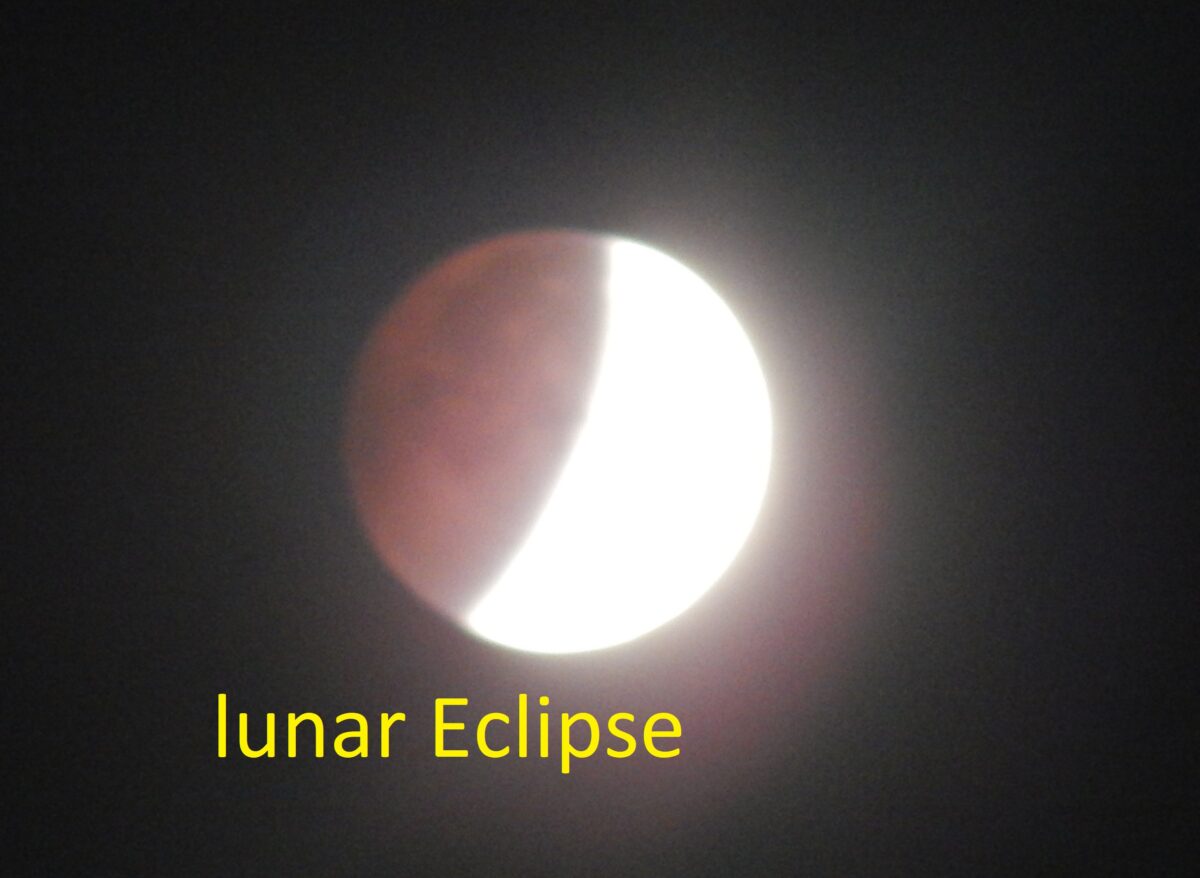
We have had two eclipses recently, the solar, and on Friday the lunar eclipse. Both partial, but up in the 90 per cents. The solar eclipse we watched from the garden. That was at a respectable hour, around 7 pm, but the lunar eclipse was at 4 am, with unlikely many takers at that hour. My daughter and I got up early to see it, first from my bedroom window on Earlham Grove, then out in the street as the moon got lower in the sky, and finally at 5 am, on the Earlham bridge over the railway, to catch the eclipse at its peak, when the earth’s shadow covered much of the moon.
Such events got me thinking about astronomy, and our place in the Universe. I took a book out the library, sadly not Forest Gate library which had a fire a week ago and is not likely to reopen for a month or more, but from Stratford. The book is The End of Everything by Katie Mack. Not the easiest read or the most comfortable. It’s about how the Universe will end. The most likely scenario is called the Heat Death of the Universe.
The Big Crunch has been rejected by cosmologists. That would be when gravity eventually pulls everything back to a situation very similar to the Big Bang. But it is reckoned the Universe is expanding too fast for that to happen. Dark energy is the force expanding the Universe, drawing it to its inexorable end. But before dark energy takes over as the villain of the piece, the end of life on earth will be caused by the expansion of the Sun.
In about 1.5 billions years, the Sun’s brightness will increase by about 10%, causing a runaway greenhouse effect on earth. The oceans will evaporate, as will lakes and rivers, killing all plants and animals and leaving the earth a lifeless, hot rock.
Well at least we’ll have a planet, you might say, looking for a little hope in such perversity. For a while. In five billion years, the Sun will begin running out of hydrogen, its fuel, and will expand, becoming a red giant which will engulf the earth.
Maybe humanity, or whatever we have become by then, will have left the earth, to wander the galaxy like some latter day Captain Kirk and his crew. But the Heat Death will get them as dark energy stretches the Universe, and even the cryogenically preserved Elon Musk will come to an end. A small blessing perhaps.
All the suns in the Universe will burn out, one by one, no new ones being formed. Darkness everywhere in space. Until in some distant time, trillions on trillions of years hence, protons and neutrons break down, the stuff that makes atoms. And we are left with no atoms at all but electrons, neutrinos and photons, getting further and further apart in the deep dark cold of the expansion. The end of anything meaningful.
It’s an end I find depressing. One likes to think the best of our culture will survive, but no, our achievements will be erased as if they never existed. Hiranya Peiris, a cosmologist at UCL, says, ‘I give talks where I say this is probably the end of the Universe, and people have cried.’
‘It momentarily makes me feel sad,’ agrees Andrew Ponzen, a cosmologist at Durham University. ‘Then I very quickly start thinking about our problems on Earth right now, and think, come on. We’re in so much deeper trouble than the Heat Death of the Universe.’
That has to be so. We have climate change, we have belligerent nations with nuclear bombs, we have germ warfare. I think of the poor people in Nepal and Tibet engulfed in a flash flood caused by a collapsed glacier hitting a river with climate change a prime suspect, and think let’s get through the next hundred years, if we can, without destroying each other. We can do something about climate change, but can do nothing at all about the Heat Death. That, at the very least, if it’s any consolation, won’t be our fault.
Which brings me to the garden and its purpose in the scheme of things. To make, in our small way, the area a better place. That’s a legacy worth living for.