
We had a mist this morning which was gone by 10 am. A mist forms when a cold front meets a warm front. The water vapour in the warm air condenses in contact with the cold air, forming the mist. It is, in effect, a cloud on the ground.
I am in a walking club, and members often dismiss mists. ‘We climbed Snowdon by the Watkins path and you couldn’t see anything as there was a mist.’ No, no. A mist is not nothing, appreciate the mist for itself. If thick, it can be very mysterious. I recall being on the top of Helvellyn in the Lake District in a thick mist. We could hear voices but couldn’t see anyone. Then shadows in the mist appeared like ghouls, and finally a group of people coming out of the tunnel of mist.
We have had a 100 mm exactly of rainfall in October. Catching up at last. Here is the rainfall going back, month by month, measured by our rain gauge, with in brackets the monthly average for London:
October 100 mm (70 mm)
September 42 (49)
August 19 (50)
July 0 (41)
June 134 (43)
May 20 (50)
April 3 (43)
The deficit from the average over those seven months is the average minus actual (346 – 318) which is 28 mm. This doesn’t seem much, but then you look at April when a farmer, say, is trying to grow a crop of spring wheat but there is only 3 mm of rain that month. The next month May is poor too. A rainy June is too late and added to by zero in July, leading to a stunted crop with a poor yield. The effect is made worse as July and August are hot months, the scanty rainfall drying up almost as soon as it falls, in our record hot summer.
In the last blog, I was asked what is the cube I was referring to. It is to one of the three metre cubes that we have. We use them to collect rainfall. They are made from translucent plastic (high density polyethylene) with all its sides measuring one metre. The most obvious cube is by the signing-in table. It collects the water from the pergola via the gutter from its roof.
What I call a metre cube is usually known as an IBC which stands for Intermediate Bulk Container, which presumably means there’s a bigger one and a smaller one too. Like the Three Bears.
I prefer the term metre cube as I like the mathematics of it. It holds 1000 litres of water. This weighs one tonne which is a 1000 kilograms, as one litre of water weighs one kilogram. You will note when you see it, that it is caged. This is because a tonne is a lot of weight and the plastic needs some help or it will bulge and maybe collapse.
The fit in these measurements is no coincidence as things were set up this way by the devisors of the metric system, the French Academy of Sciences in the 1790s, a spin off from the French Revolution. Far better than cutting off heads.
For those who like big numbers, the cube’s sides are one metre each or 100 centimetres. So the volume is 100 x 100 x 100, which gives 1 million cubic centimetres (or millilitres). So if you ever have the urge to visualise a million, look no further than one of our metre cubes.
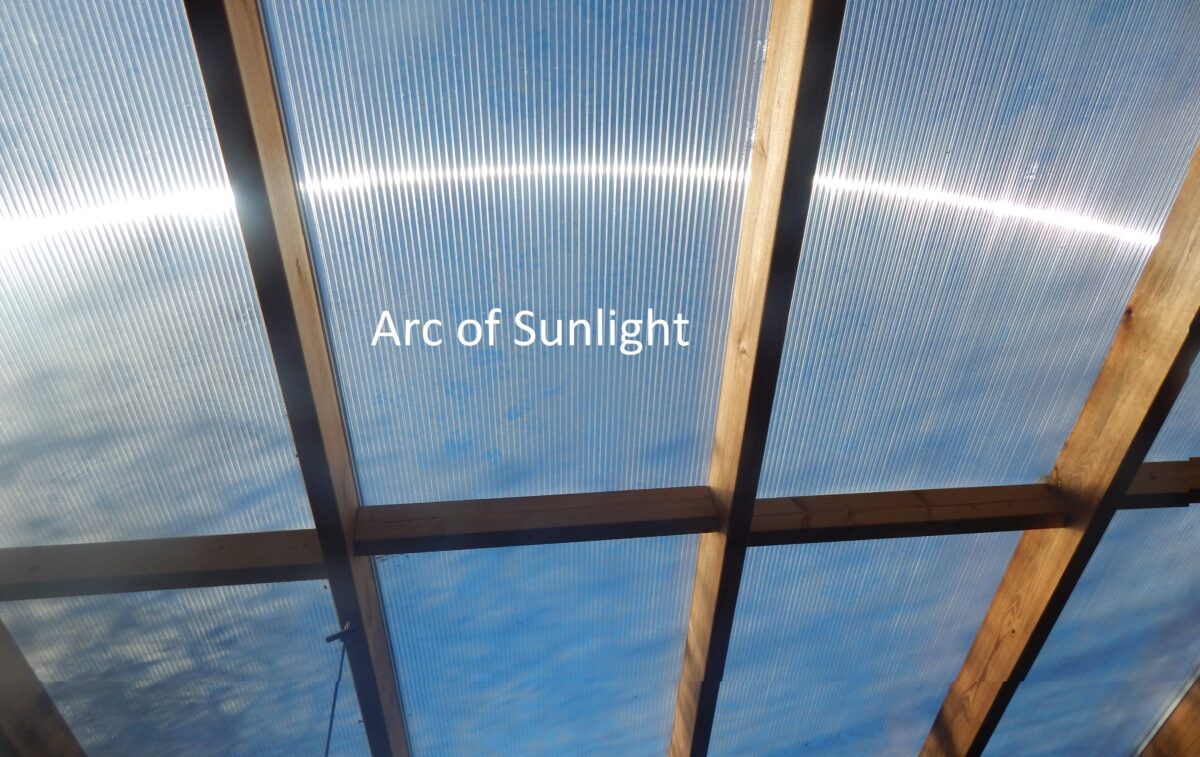
I was in the shelter around midday when I noted a curve of sunlight through the transparent plastic roof, like a sunlit rainbow but without the colours. The roof has parallel ribs about half a centimetre high and each was catching the sun, giving an arc of light across the span.
Comments 1
A lot of interesting numbers, Derek. A pleasure to read.