
There’s a sprig of wheat in the wildflower bed, quite short as the bed is dry. It has sprouted from bird seed. There’s a bird feeder over the bed, and birds are quite messy eaters, and seeds drop to the ground and some sprout. I first noticed this when I did the Cereal Project in 2020. We grew a variety of cereals including maize, oats, and barley but the only wheat I had was emmer wheat and Red Fife wheat, both interesting but neither modern. Emmer is one of the earliest wheats, dating back 11,000 years to when wheat was first domesticated in the Fertile Crescent in the Middle East. Red Fife wheat was given to me by a friend in Saskatchewan, Canada, who runs a small business, Prairie Garden Seeds, selling mostly heritage cereal seed. Red Fife Wheat was popular up to 1900 in Canada but has long been superseded. So we lacked a modern wheat, until I found some growing under the bird feeder hanging from the white flowering cherry. I dug some up, and added it to our project.
It’s been very dry this month. The rain gauge collected 1 mm of rain on 1 August and that has been it. The average rainfall for August, in London, is 53 mm, so by now we should have had around 15 mm instead of the measly 1 mm. We had a good supply in our water barrels from July, which was a rainy month, but that is going quickly these warm, dry days. I heard on the news that this year is going to be a bad one for UK peas. The dry months of May and June stunted their growth; July rain was too late. I would expect this will be a bad year for vegetables in general and cereals too, for the same reason.
Today is windy and warm, good drying weather my mother would have said. Fine for clothes on the line, but not so good for our soil which is rapidly losing any moisture. This drought is bad for birds, for frogs too that have left the pond. Such harsh weather is why living things tend, in our view, to over breed. The reason is simple enough, so some at least will survive to breed in their turn.
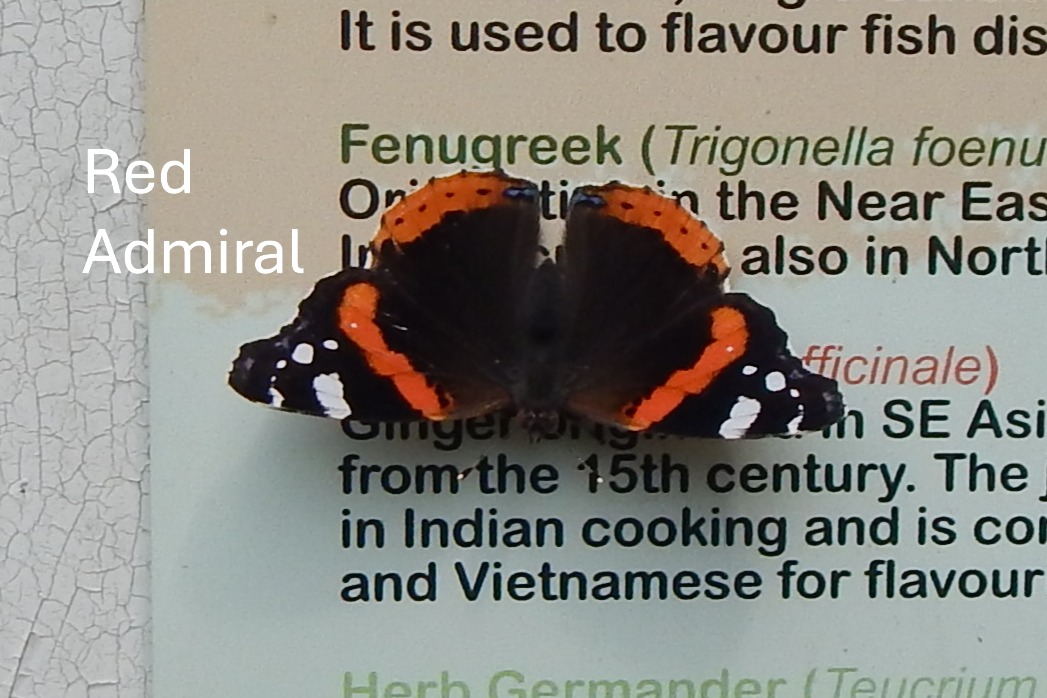
The globe thistles in the raised herb bed have lost their blue colour, becoming a spiky grey, like the hair of the elderly. Perhaps students of the University of the Third Age, having missed the ukulele course they are studying butterflies. A red admiral, unfortunately out of their sight, lands on the herbs and spices dibond. It stays there for several minutes, only flying off when I come in too close.
Teasels, also in the herb bed, have lost their colour too. They remind me of the flax project I am going to suggest to the Steering Group for next summer, as teasels were used, in the 19th century, to scrape flax stalks to release the fibres. There are two flax plants in the wild flower bed, both in flower. When the flowers die, I will have a go at getting at the fibre within the stalk, to see how difficult it is.
The Dare to Dream back stage has been re-roofed with clear polycarbonate, but it is not in use yet. The structure is wood, and the past years, especially the winter months, have rotted quite a bit of it, and so slats have to be replaced. We are taking the opportunity to make it more spacious. Once completed, we envisage it as a quiet area, perhaps utilised by art projects.
We empty the nest box attached to the sycamore. There’s about 4 cm of nesting material inside, surprisingly still green. It is soft and spongy, some of it made up of hornwort from the pond. Back in April, we watched the parents going in and out of the box, so busy feeding their brood. There can be upto nine nestlings, all demanding to be fed. There’s a little fluff on the nesting material, discarded as the nestlings grew feathers. In two months, they were gone. Perhaps some are coming back to our feeders.