
The autumn equinox fell on Wednesday, 23 September this year. The equinox varies, year to year, from 22 to 23 September usually. Though, very occasionally it can be on 21 and 24. The next time it will fall on 21 September is 2092. It will not occur on 24 September until 2303!
The variance is because our year, the time it takes for the earth to go round the sun, is 365 ¼ days. So the equinox is a quarter of day later each year for three years, and then we get the leap year and with it the extra day (366) which catches up and resets. That accounts for 22 and 23 September. The extreme dates are to do with what the Gregorian calendar does at centuries. Only those divisible by 400 are leap years and so get the extra day. Those dropped days account for the 24 September date in 2303.
The actual time of the equinox this year was 1.06 am on 23rd September. You might wonder why it is a specific time and not the whole day. This is because the equinox is an astronomical event. It occurs when the earth’s equator, if extended, would pass through the centre of the sun’s disk. Though on the day itself, every place on earth gets more or less 12 hours day and 12 hours night.
The increasingly longer nights give us chilly mornings, though when the sun does get up we are getting above average temperatures. It’s 23 degrees as I write this blog. There are some flowers around, second comings in this Indian summer. The papyrus in the pond is well over a metre high. It has loved the hot summer, and with its roots in the water mud had no problem with drought.
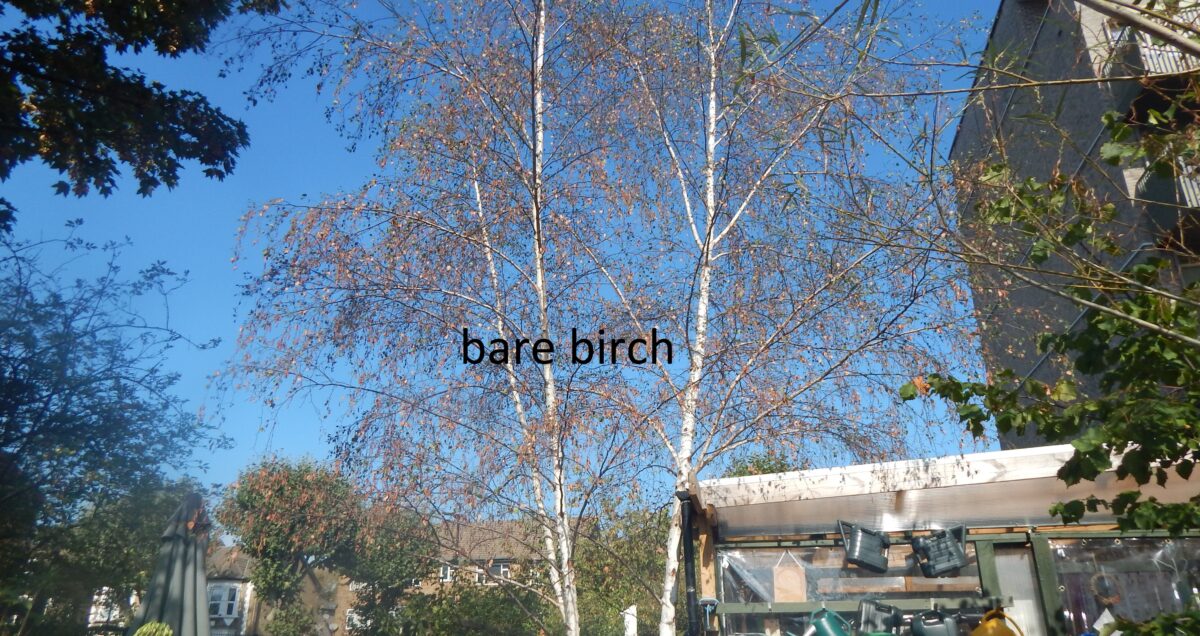
The last 10 days have been dry, with 1 mm of rain on the 17th which is next to nothing. This is disappointing as we are hoping to at last catch up after a very dry summer, with no rain at all in July. The silver birch has lost most of its leaves. That is so early. It surely reacting to water shortage, made worse by the heat. The summer has been the hottest on record for the UK, says the Met Office. The maximum daily temperature over the summer (June, July and August) was 21.3 degrees which is 2.4C above what it was for summers between 1991 and 2020. It includes night time temperatures; day time temperatures were around 10 degrees warmer. This year on year rise is becoming unstoppable, with fossil fuels the villain of the piece.
The hot dry summer has had an assortment of effects on fauna. I haven’t seen any spiders webs this month. These are the days when the females usually build their webs and mate. Did the heat and drought kill them off? Will there be a recovery? Climate change will drive many arachnids and insects to extinction. Birds too are having a hard time. Apart from drought, the increasing heat messes up their migration cycle, as the UK becomes less suitable for them.
We have two apple trees, but neither bear fruit. I am sure they need a pollinator. Perhaps we should get a crab apple tree for this. All the pear trees have fruit, so they do have a pollinator.
Tomorrow there’s a plant sale in the garden and a MacMillan Coffee Morning.